
Comparing candidate molecules
You need a consistent basis for comparing small molecules, peptides, or antibodies before selecting candidates for further development.
CRO · Early-Stage Research
HUAHE undertakes early-stage radiopharmaceutical research to help you decide which candidates merit further development. Research brings together target biology, molecular properties, radiolabeling feasibility and in vivo behavior to compare candidates, identify risks and define the evidence needed for the next decision.
Discuss early-stage research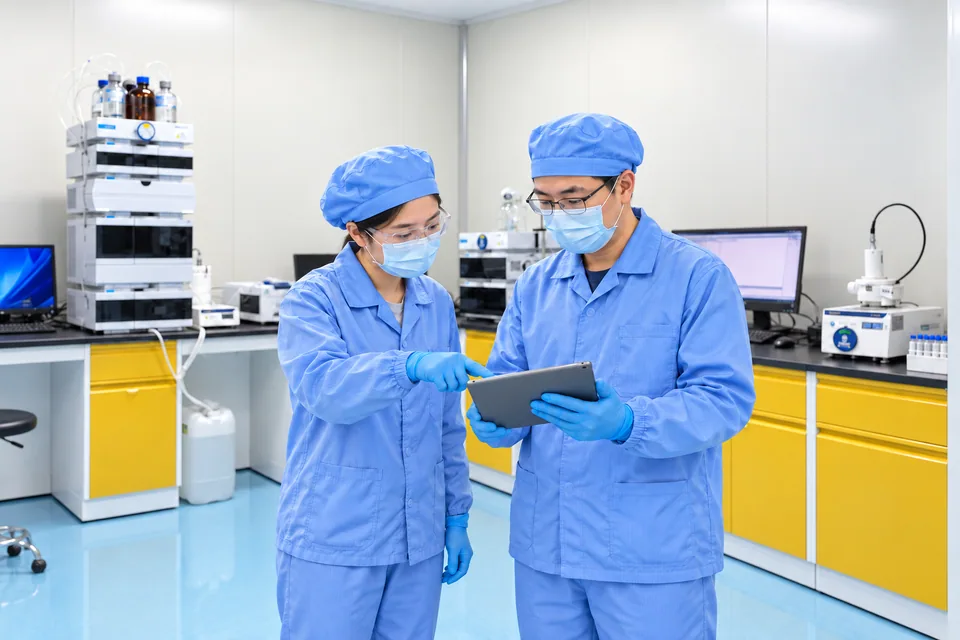
Your starting point
You need a consistent basis for comparing small molecules, peptides, or antibodies before selecting candidates for further development.
You want to assess radionuclide suitability, radiolabeling feasibility, and the analytical characteristics of a candidate.
You need comparable data on target uptake, clearance, and organ retention to judge whether a candidate is ready for the next study.
Scope of work
HUAHE executes the agreed work and delivers the agreed outcomes, with scope and acceptance criteria defined for each project.
Assess target expression, accessibility, binding affinity and specificity in relation to the intended research question.
Compare small-molecule, peptide or antibody formats, molecular stability and nonspecific binding.
Assess radionuclide suitability, conjugation strategy and radiolabeling conditions in relation to the target and molecular requirements.
Use HPLC with radioactivity detection and radio-TLC scanning to compare retention times, peak areas and peak shapes, radiochemical purity, chromatographic profiles and stability under consistent analytical conditions and at defined time points. Record equipment status, sample information and raw data together.
Define study groups and sampling or imaging time points. Combine PET/CT, SPECT/CT and biodistribution studies with quantitative measurements within regions and volumes of interest (ROI/VOI), tissue uptake ratios, time–activity curves and preliminary dosimetry estimates to compare target uptake, blood-pool clearance and retention in critical organs, and assess potential imaging or treatment time windows in research studies.
Project outcomes
You receive an early-stage research package supporting candidate ranking, risk identification and decisions on further development, with proof-of-concept findings and evidence-based recommendations for the next stage.
This service provides research-stage developability assessment and is not a substitute for Good Laboratory Practice (GLP) safety studies, Good Manufacturing Practice (GMP) manufacturing, or testing for regulatory submission or batch release. Analytical method validation or verification and quality review must be appropriate to the intended use and applicable requirements.
Tell us about your organization, candidate type, current research stage, and the non-confidential question you want to address.
Discuss early-stage researchConnected expertise
HUAHE integrates process and analytical development to build the process understanding needed for scale-up, process control and technology transfer.
Explore service Global supply · Lutetium-177 (Lu-177)HUAHE supplies no-carrier-added (n.c.a.) lutetium-177 chloride solution to global clients through its strategic Qinshan partnership.
Explore service Global supply · Actinium-225 (Ac-225)HUAHE supplies no-carrier-added (n.c.a.) actinium-225 chloride solution to clients worldwide, managing international sourcing, order planning and batch confirmation.
Explore service